
What Is a DEX? A Simple and Complete Guide
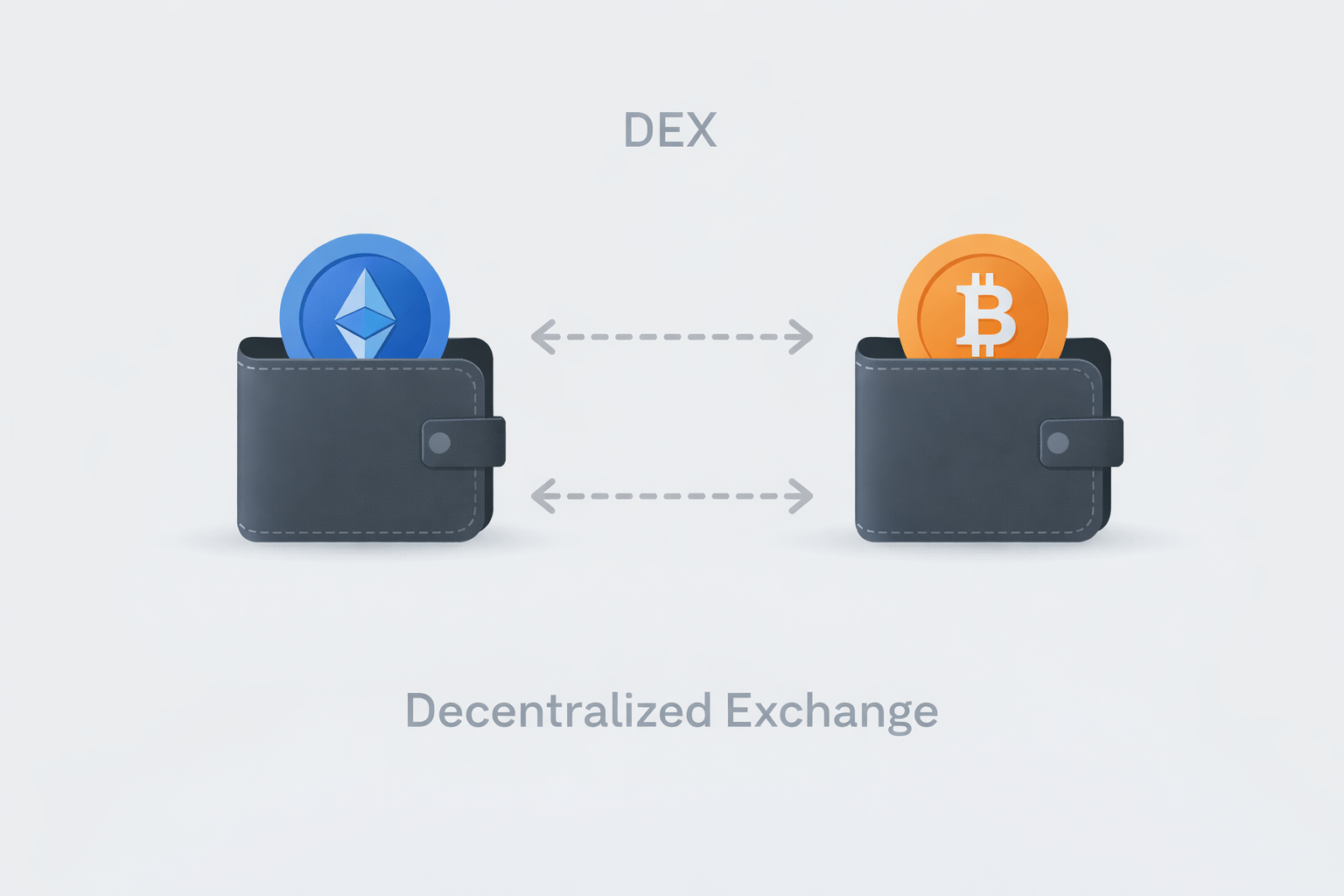
A Decentralized Exchange (DEX) allows users to trade cryptocurrencies directly with each other, without intermediaries such as banks or centralized companies. Built on blockchain technology and powered by smart contracts, DEXs offer transparency, self-custody, and permissionless access to financial markets.
Introduction
If you’ve entered the crypto world, you’ve probably heard about DEXs — especially when people talk about DeFi, self-custody, or “not your keys, not your coins.”
But what exactly is a DEX?
In simple terms:
A DEX (Decentralized Exchange) is a platform that allows users to trade cryptocurrencies directly from their wallets, without relying on a central authority.
There is no bank, no broker, and no company holding your funds.
Instead, trades are executed by smart contracts on the blockchain.
1. Centralized Exchange (CEX) vs Decentralized Exchange (DEX)
To understand DEXs, it helps to compare them with centralized exchanges.
| Centralized Exchange (CEX) | Decentralized Exchange (DEX) |
|---|---|
| Company controls the platform | No central owner |
| Users deposit funds into the exchange | Users keep funds in their own wallets |
| Requires KYC and accounts | Usually permissionless |
| Internal database | Blockchain-based smart contracts |
| Custodial | Non-custodial |
With a DEX, you always control your assets.
2. How a DEX Works (High-Level Overview)
DEXs operate using smart contracts deployed on blockchains like Ethereum, Arbitrum, Polygon, or BNB Chain.
The basic flow is:
- You connect your wallet (e.g., MetaMask)
- You choose tokens to swap
- A smart contract executes the trade
- Tokens move directly between wallets
No deposits.
No withdrawals.
No intermediaries.
Everything happens on-chain.
3. Automated Market Makers (AMMs)
Most modern DEXs do not use traditional order books.
Instead, they rely on Automated Market Makers (AMMs).
What Is an AMM?
An AMM is a smart contract that sets prices using a mathematical formula, based on token supply and demand.
The most common formula is: x × y = k
This model was popularized by Uniswap, one of the first major DEXs.
4. Liquidity Pools: The Heart of a DEX
Instead of buyers and sellers matching orders, DEXs use liquidity pools.
A liquidity pool:
- Contains two tokens (e.g., ETH / USDC)
- Is funded by users called liquidity providers (LPs)
When you swap tokens:
- You trade against the pool
- The pool automatically adjusts prices
Liquidity providers earn:
- Trading fees
- Sometimes protocol incentives
5. Self-Custody: You Control Your Funds
One of the most important features of a DEX is self-custody.
This means:
- Your private keys stay with you
- Your assets never leave your wallet
- The protocol cannot freeze or seize funds
This design removes counterparty risk — a major problem seen in centralized exchange failures.
6. Transparency and Trustlessness
DEXs are:
- Open-source (code can be audited)
- On-chain (transactions are publicly verifiable)
- Permissionless (anyone can use them)
You don’t need to trust a company.
You can verify the system yourself.
Trust is replaced by code + cryptography.
7. Popular Examples of DEXs
Some well-known decentralized exchanges include:
- Uniswap (Ethereum and Layer 2s)
- Curve (optimized for stablecoins)
- Balancer (customizable pools)
- PancakeSwap (BNB Chain)
Each follows the same core principles, with different optimizations.
8. Risks and Limitations of DEXs
While DEXs are powerful, they are not risk-free.
Smart Contract Risk
- Bugs or vulnerabilities can lead to loss of funds
Impermanent Loss
- Liquidity providers may lose value compared to holding tokens
Slippage
- Large trades can significantly affect price
User Responsibility
- No customer support to recover lost funds
- Mistakes are irreversible
DEXs shift responsibility from institutions to users.
9. Why DEXs Matter in DeFi
DEXs are foundational to decentralized finance because they enable:
- Permissionless markets
- Global access to liquidity
- Financial inclusion
- Composability with other DeFi protocols
They are not just exchanges — they are financial infrastructure.
Conclusion
A DEX (Decentralized Exchange) is a core building block of the decentralized financial system.
It allows users to:
- Trade without intermediaries
- Keep full control of their assets
- Rely on transparent, verifiable code
DEXs are not designed to replace everything overnight — but they redefine what is possible when trust is decentralized.
For anyone entering DeFi, understanding how DEXs work is essential.